

Your Grandchildren May Not Exist.
Not because people don't want them. Because the structure of modern adulthood got there first.


I was born in 1979. Technically that makes me Generation X, the tail end of a cohort described as sceptical, self-reliant and sarcastic. I’ve always struggled to buy into the idea that everyone in a fifteen-year window is the same. However, I do agree that there are experiences that shape us and when those happen in your formative years the impact is greater.
Generations are groups whose value systems and behaviours were formed by common experiences during late childhood and early adulthood. The events that hit you while you are coming of age leave a mark. The post-war boom shaped the Boomers not as a memory but as the fuel of their childhood.
When the world feels unstable, people look to the cohort around them for orientation. Identity crystallises around shared experience, shared uncertainty, shared loss.
In my formative years I had two full time working parents, watched the rise of corporate culture and the fall of the Berlin Wall. And I spent my teenage years on a Commodore 64 and Sega Mega Drive.
My recent research has made me question what generational names are really describing? What do they tell us about adulthood? When you look closely, they are not all doing the same thing.
Most Generations Are Named for Culture
Most generations are named at birth, for the world they are born into.
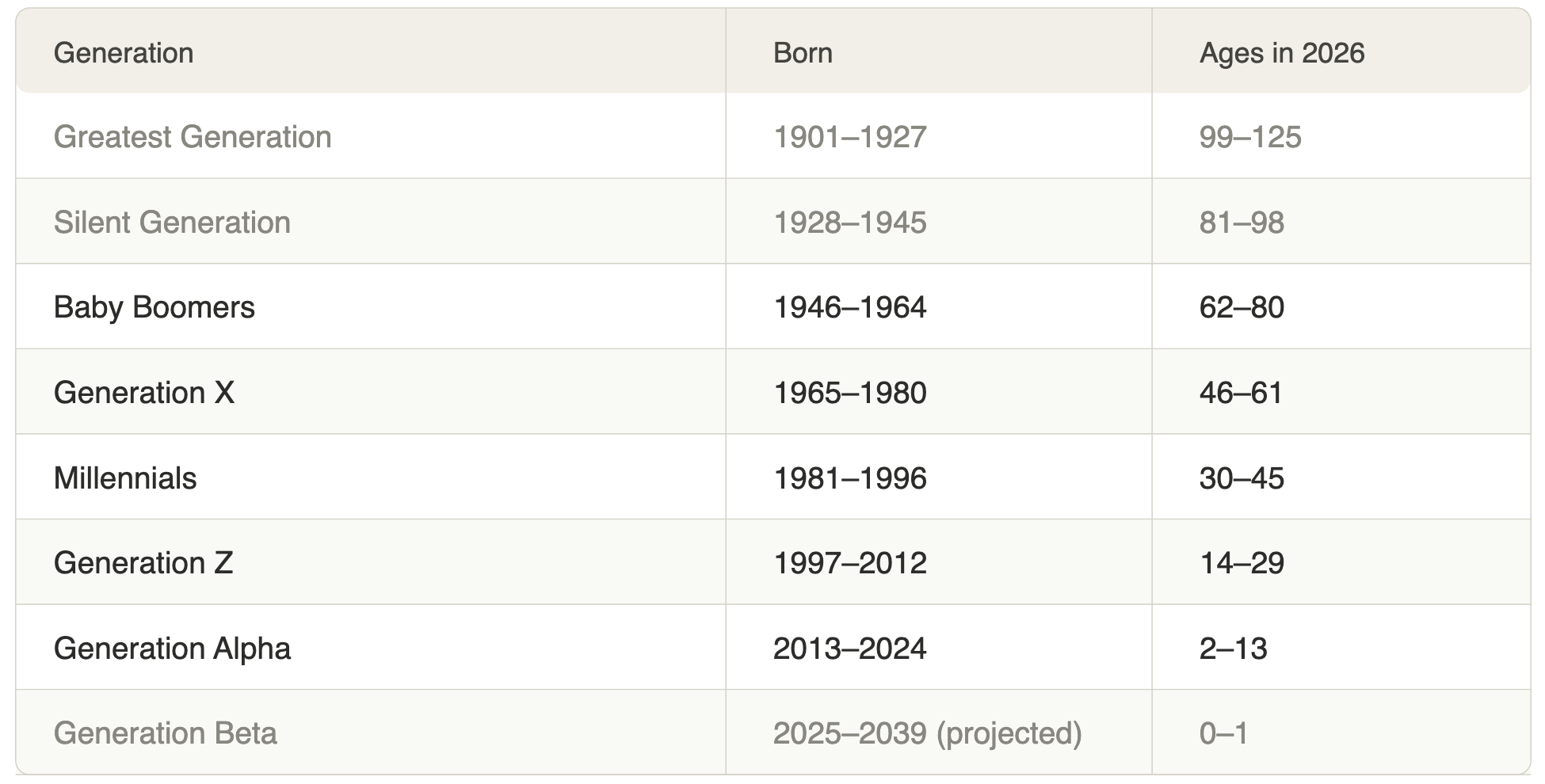
Gen X was named for a cultural mood, Douglas Coupland’s novel gave my generation its label before demographers caught up. Millennials were named for the turn of the century they came of age around. Gen Z continued the alphabet. Gen Alpha started it again.
One generation broke the pattern. The Baby Boomers were not named for their attitudes or their aesthetics. They were named because they were a demographic fact, the unusually large cohort produced by the post-war surge in births. The name described what happened to the population, not what kind of people they were. Because there were so many of them, they reshaped everything they moved through: schools, housing markets, the labour force, politics, pensions. They were named for a surge.
I’ve been thinking a lot about the opposite. Which generation might be framed by the opposite, the reduction in births. A time when the majority don’t become parents.
I’ve called it Generation Zero – named the opposite of a boom.
But here is the distinction that matters most. Generation Zero is not a generation. It is a threshold.
It does not replace Alpha or Beta in the sequence. It does not describe a cultural cohort born in a particular window. It is the name for a demographic line, the point at which a cohort moves through its entire reproductive life and the majority of its members never become parents. That line sits above whichever generation crosses it. We will not know which one that is until after they have already lived their lives.
Every generation gets a cultural name at birth. Generation Zero is the name we will give to the moment, not the people.
The Threshold Is Getting Closer
No developed country has crossed the threshold yet, but the direction of travel is clear.
Cohort childlessness, the share of people who reach the end of their reproductive years without having children, has roughly doubled since the mid-twentieth century across most developed nations. Women born in the 1930s saw childlessness rates of around 10 to 15 percent. For women born in the 1980s, estimates and projections now sit between 20 and 30 percent in many countries. In Germany around 25 percent. In Japan closer to 28. In the UK, around 20 percent of women born in 1970 never had children, with projections suggesting that could rise to 25 for women born in the early 1990s.
South Korea sits at the extreme end. A total fertility rate of approximately 0.7, less than a third of what is needed to sustain population. When combined with rapidly rising rates of women in their early thirties who have never married their trajectory is clear.
In the UK deaths are expected to outnumber births for the first time in 2026.
Unlike generation cohorts, countries will pass the Generation Zero threshold at different times. South Korea, Japan and Southern European countries are closest to surpassing an unprecedented demographic threshold.
The oldest of Gen Z are entering their prime fertility years now. Gen Alpha are just reaching their formative years and what surrounds them in this moment will shape how they imagine adulthood, relationships and family life.
Children Inherit a Sense of the Future
Every generation inherits an idea about the future before it inherits politics or economics. Children absorb it indirectly through the emotional atmosphere around them. Whether adulthood looks stable. Whether relationships appear durable. Whether having children feels normal, achievable, or reckless.
For most of the modern era, developed societies carried a basic assumption that the next generation would live better than the last. Not perfectly. Not equally. But better. The logic of progress held.
That confidence now looks less stable.
None of this means people are wrong to choose not to have children. Smaller families may be a rational response to modern life, or simply a different vision of adulthood. The question is not whether parenthood is morally necessary. It is whether younger generations still imagine it as realistic, desirable, or compatible with the lives they expect to live.
Millennials, now aged 30 to 45, are the first modern cohort projected to be worse off than their parents across several measures: housing, pension security and long-term financial stability. Gen Z are watching that unfold in real time. Gen Alpha are growing up inside homes shaped by it.
And each generation is becoming smaller than the one before it. Fewer siblings. Fewer cousins. Fewer classmates. Fewer children visible in everyday life. A shrinking generation does not just change demographics. It changes the emotional sense of the future. Expansion feels normal. Contraction does not.
Four signals are present simultaneously in the culture Gen Alpha and young Gen Z are absorbing now.
Economic: Adulthood, as modelled by the generation immediately ahead of them, is expensive, precarious, and slow to stabilise. The career stability that was supposed to arrive in your mid-twenties now arrives, if it arrives, in your mid-thirties. The home that was supposed to follow shortly after remains, for many, hypothetical.
Structural: They are growing up in smaller families, with fewer siblings, fewer children in their immediate environment. Children raised in large families experienced parenthood as part of the texture of ordinary life. Younger generations increasingly encounter it as something postponed, negotiated, expensive, or absent entirely. It has become something adults discuss rather than something children grow up surrounded by.
Relational: The stories being communicated to young men and young women about what the other gender is, what relationships cost, and whether partnership is worth pursuing are increasingly divergent fuelled by algorithmic content designed for engagement rather than accuracy. The divergence is real, measurable, and it is arriving during the precise years when value systems are solidifying.
Physical: Across developed countries, rates of sexual inactivity and relationship formation are declining among young adults. Japan is the clearest example. More than half of adults aged 20 to 24 report never having had sex. Similar patterns are emerging across the US, UK and parts of Europe. Falling intimacy does not automatically lead to falling parenthood, but the two trends are increasingly moving together. Japan, with a fertility rate of 1.15, is not an anomaly. It is an advanced signal.
None of these four signals are intentional, they are the accumulated output of a culture, an economy, and a technological environment that were not designed with the next generation’s imagined life in mind. We are focused on what is happening now, impacting those at prime fertility age, not how it is shaping the aspirations of the next generations.
These signals may shape whether in some countries Gen Beta will become the first cohort that crosses the threshold where less than half of them become parents.
We Will Only Recognise It in Retrospect
The Baby Boomers were named in something close to real time. The surge was visible as it happened. Demographers saw it. Journalists named it. The consequences became clear as their large cohort moved through schools, housing markets, politics and now retirement systems.
Generation Zero will not work that way.
The threshold will not announce itself in maternity wards or headlines. It will emerge slowly in demographic data, cohort by cohort, only visible once a generation has moved through its reproductive years.
Which means the real question is not demographic. It is cultural.
What does adulthood currently look like to the children now entering their formative years? What assumptions are they absorbing about relationships, stability, intimacy and family life? What kind of future do they believe is waiting for them?
Every generation is shaped by the world it grows up inside. The generations now forming their understanding of adulthood are doing so in societies where fewer people are becoming parents, where family formation is delayed, and where confidence in the future appears weaker than it did for the generations before them.
The first generation to cross the threshold will not know they were living through it.
This is part of a series examining the forces shaping Generation Zero. If you’re new here, start with Generation Zero, Modern Women Live Between Two Clocks and What the Screen Taught Us.
I really like the section on the four forces shaping this culture. For some adults, the desire to build families is present but there are structural issues ie. job market instability & cost of housing that block these goals. And many are still coming to terms with the fact that traditional adulthood no longer exists as “timelines” have just become longer